After taking a summer break, I'm happy to announce that my free teleclass series is starting up again in September. The next free teleclass is on a specialized topic: Emotional Eating, Overeating, and Success After Weight Loss Surgery. If you are someone who has had weight loss surgery or is considering it, this call is for you.
The teleclass takes place Wednesday September 3, 2008 at
3 pm Eastern, 2 pm Central, 1 pm Mountain, and noon Pacific time.
If you can't attend, don't let that stop you from registering. The call will be recorded and registered participants will receive access to the class recording after the call. If you've never attended a teleclass before, they're easy. You'll just dial in on the phone number you will receive when you register (you are responsible for any long distance charges) and when prompted you'll be given an access code to enter.
You can go here to register and when you do, you'll have an opportunity to submit a question that you would like addressed. I'll try to get to as many as I can on the call. Hope to "see" you in class!
Take good care,
Melissa
Wednesday, August 13, 2008
Free Teleclass Coming Your Way!




Tuesday, August 12, 2008
More Thoughts on Hunger and Emotional Eating: Hara Hachi Bu
 The Japanese have an expression, hara hachi bu, or “eat until you’re 80 percent full.”
Residents of the Japanese island of Okinawa, who are among the longest living and healthiest people in the world, have traditionally practiced hara hachi bu. The practice is to be mindful of your eating and eat only until you are 80 percent full.
To try hara hachi bu, eat until you feel “mostly full,” then wait 20 minutes. Pay attention to what the experience is like for you. Notice what that 80 percent really feels like.
Stopping at 80 percent fullness is actually a healthy strategy because it takes the stomach time to communicate fullness to the rest of the body. Many who stop at 80 percent will feel satisfied and will ultimately eat less. If you are accustomed to eating until you are more than 80 percent full, you might find that this stopping point leaves you less sleepy and more energetic after meals.
Practicing hara hachi bu is an excellent way to play with your experience of hunger and fullness. View it as an experiment. What does it feel like to leave the table with extra room? How difficult is it to assess that 80 percent feeling? Are there emotions or reactions that come up for you when you experiment with eating in this way?
Take good care,
Melissa
Monday, August 11, 2008
What do you do about hunger?
 What kind of relationship do you have with your hunger?
Are you aware of feeling hungry?
Where do you feel it in your body?
On a scale of 1 to 10 (1 = empty and 10 = filled to bursting), how hungry do you let yourself grow before you eat?
Do you make a decision to eat based on body sensations of hunger, or based on the clock (it’s 6:00 so it’s dinner time), or based on the fact that your coworker left cupcakes by the coffeemaker?
How does it feel to be hungry? You may never have thought about this before, but I urge you to take some time to pay attention and explore this. Some people start to feel a little panicky when they get hungry. Some people block it out and aren’t even very aware of feeling hungry until their hunger feels enormous. Some people even get angry with themselves when they are hungry.
It’s incredibly important to pay attention to our hunger and the signals we are getting from our body. Many of us could get better at that. However, paying attention is only the first step. The second step is making a decision about how to respond to our hunger. Emotional eaters tend to feed hunger as well as emotions with food rather automatically—without giving it much conscious thought.
Consider this—often our responses to our hungers (both physical and emotional hungers) are learned in the family we grew up in. These responses are so automatic that we might not even realize that there is another way to approaching times when we feel hungry. What would happen if you got curious about your hunger? If you took a step back and observed it, if you didn’t respond the way you normally do and allowed yourself to observe what that was like?
Here are some ideas:
Note your hunger patterns. If you normally wait until you are about a “5” on the hunger scale before eating, what would happen if you waited until you felt more like your hunger was a “4”? How long would it take? Would that be uncomfortable? Would it bring up emotions or concerns?
If you normally eat until you are a “9” (very full), what would happen if you stopped at “7” and waited 30 minutes to see how you felt? What if you tried stopping at “7” all week?
Are you someone who goes from extremes of “starving” to feeling way too full? What if you made a commitment this week never to let your hunger get below a 3 or a 4 on the scale?
Remember—these are not dieting challenges or tricks. These are techniques for being curious about your hunger and observing and listening to your body.
Take good care,
Melissa
Saturday, August 2, 2008
Don’t Sabotage Your Weight Loss: Slow Down!

Not taking the time for our own needs and self-care often turns out to be a direct path to overeating, stress eating, and weight gain.
All the women I know are busy, busy, busy. We try to do too much. We think that we can somehow squeeze extra hours out of the day.
We skimp on sleep, eat on the run, and steal from our own self-care time in order to get to the things on our “to-do lists.”
Big mistakes.
When we don’t allow time for what we really need or desire, it’s tempting to use food to try to “fill in the gaps.” A quick snack or a “treat” becomes the reward that’s supposed to take the place of the real need or desire we didn’t allow ourselves to address.
The problem is, food just becomes a band aid. Eating and food don’t really solve the problem. Eventually the desire or the need comes back and we start the vicious cycle all over again.
If you want to take control of emotional eating, if you want to lose weight and keep it off, then it’s vital to address this cycle head-on. It’s essential to learn about the tools that help you slow down and find ways to really feed your needs—in a way that chocolate and French fries never will.
Take good care,
Melissa
PS: If you haven’t signed up for my free Self-care package, now would be a good time. Just enter your information in the top right corner of this page and I’ll send you a short weekly audio each week for five weeks. These to-the-point lessons will help you create more balance and more focus on YOU in your life—no matter how busy you are.
Thursday, July 31, 2008
Life Coaching 101: 3 Steps to Moving Forward and Getting Where You Really Want to Go
 As a Life Coach, I help people get where they want to go and do what they’ve always dreamed of doing.
Over and over again I’ve seen people achieve tremendous goals and create enormous change—the kind of progress that tends to make other people say, “Oh, I could never do that!”
My clients leave the jobs they hate and create satisfying new career paths. They lose the weight they are tired of battling. They make significant emotional or geographic moves. They move forward.
And then my clients tell me how they encounter people who look at them with awe and say, “Oh, I could never do that.” My clients just smile--because they know the secret (and I’m not talking about the law of attraction). The secret I’m talking about is this: In order to achieve great things, you don’t have to know exactly how you are going to get there in order to get started. In fact, getting hung up on the specifics can freeze up your progress before you ever even get underway.
“Reasonableness” is not the first step. My advice—banish your practical or skeptical thoughts until you’ve asked yourself the following four powerful questions:
1.What do you really want?
Remember, this is not the time for practicality or thought censorship. Think big. Be specific. DO NOT edit down your goal to something that seems “attainable.” If what you want is a house on the Mexican Riviera, don’t write down a week in a time share. Let your imagination and your dreams soar. Make a list.
Now pick the most enticing item on your list and ask yourself:
2.What would it take to get where you want to go?
Don’t worry about how you would do these things; just list all the steps you think would be involved. Break the steps down as much as you can. Circle the steps you would need help with or would need additional information or support to complete. If the steps seem overwhelming, break them down into smaller steps.
3.Who could help you?
Again, don’t let “reason” be your guide. You can have Oprah on your list right next to your best friend. Write down every resource you can think of and then brainstorm who could help you connect with that person or someone else like them. Don’t just think about the people you know, think about the step that you would need help with. Ask yourself,”Where would someone go to get help with X?”
4.Looking at your answers, what is the first do-able step you could take in the next week that would get you moving in the direction you want to go?
Hint: the first step is usually smaller than you think it “should” be but it will often end up being far more powerful than you anticipated—as long as you commit to taking another step once you’ve completed it. Your first step might be making a phone call, doing some research, making a connection with someone, or even making another list.
With these four steps, you’ve gotten the ball rolling. Now your job is to keep it in play. Keep moving forward, identifying the next do-able step and taking action. When you hit a stuck spot (you will—we all do), that’s your cue to break the step down further and/or go back to question 3.
Your Challenge: Ask the questions and take the steps. Let me know what you’re working on. I’d love to feature your stories in a future article.
Take Good Care,
Melissa
Tuesday, July 29, 2008
The Power of Small Steps
 The demands of life are many. Believe me, I feel it too. It’s easy to get swept up by responsibilities and life expectations and distracted from our goals, our dreams and our aspirations.
And sometimes, when we see where we want to go—so far off in the distance—the distance to cover can seem overwhelming. Sometimes it seems too far away to even contemplate starting the journey.
The problem is, if you don’t start, you won’t get there.
Here’s the truth. The distance from where you are now to where you want to go is rarely as far away or out of reach as you think, AND the path you lay out at the beginning isn’t always the path you’ll end up taking, AND good things often happen along the journey to break up your trip, spice up your life, and make the trip a reward in itself.
Momentum begins when you take the first step. Any step. And it continues when you pick up your other foot and put it in front of the one you just moved. As you get moving, you DO figure it out—and the momentum you create by being in action will propel you further forward.
My challenge to you: What small concrete step can you take today that will get you closer to where you want to go?
Take good care,
Melissa
Wednesday, July 23, 2008
Emotional Eating Problem Solving: Top Ten Reasons for Getting Stuck
 A few weeks ago I was sorting through school work and papers that came home in my fifth graders backpack at the end of the school year and had been left in a pile. In his math folder I found this great handout: "Problem-solving Top-ten List." It's intended to help students who are stuck on a math problem, but I found it to be great life advice and very applicable to eating and weight loss battles. What do you think?
Top Ten Reasons For Getting Stuck in the First Place:
1. You tried to rush through the problem without thinking.
We are often great at rushing into new weight loss programs and diets hoping each one will be the magic answer. Clients often tell me how they've picked programs in the past that weren't compatible with their tastes or their schedules or their preferences and that they probably knew from the beginning they wouldn't want to continue with long term.
2. You didn't read the problem carefully.
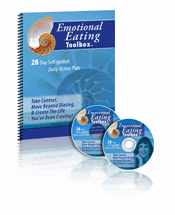
We don't just run into this difficulty with math problems. In many life situations, if we don't clearly understand the problem, we might choose a problem solving approach that isn't going to meet our needs. In the Emotional Eating Toolbox(TM) 28-Day Program, I encourage users to take the time to understand their unique situation. Taking the time to understand your reasons for overeating and the types of solutions that will work for you is essential to not getting stuck further down the road.
3. You don't know what the problem is asking for.
Again, this doesn't just apply to math problems. If we're working to solve the wrong problem, we aren't going to get anywhere. If you are struggling with emotional eating (stress eating, boredom eating, or eating when you are lonely or upset), no food plan or diet in the world is going to fix that--because it's not about the food--it's about figuring out what to do with the feelings.
4. You don't have enough information.
I often tell me clients that if they feel like they aren't getting anywhere, or if they feel like they are beating their head against the wall, odds are that there is a part of the problem that isn't being addressed. The Emotional Eating Toolbox(TM) spends a significant amount of time showing you how to collect information about yourself, about your hunger, and about your relationship with food so that you can solve the eating problems once and for all.
5. You're looking for an answer that the problem isn't asking for.
If you overeat because you are bored or stressed or anxious or angry (or any other emotion), the problem isn't about food choice. The answer the problem is asking for has to do with finding new or better ways of responding to your emotions, your stress, and your needs. The weight loss industry spends billions of dollars convincing us that if we follow a certain diet we will be beautiful and happy. I meet far to many of my clients because they feel like they haven't been able to be "strict enough" with themselves. They are angry with themselves because they haven't been successful with weight loss plans that stress deprivation and willpower and denial.
The truth is that diets aren't the answer for this problem. Enduring change and enduring weight loss happen when we make changes that work with our lives--not when we try to maintain behaviors that leave us hungry and grumpy and feeling like we are missing out.
6. The strategy you're using doesn't work for this particular problem.
I'll say it again. Diets tell you what to eat. Often, being on a diet will increase the amount of time and energy someone spends focusing on food. Diets don't teach you how to change patterns of emotional eating or overeating when you aren't hungry. They don't teach you how to feed yourself and expand your life in ways that won't leave you feeling deprived. Users of my program are often surprised at first how little time they spend focusing on food. The program doesn't count fat grams or calories or carbs. The program helps you target the reasons you feel hungry and the reasons you eat when you aren't. The program helps you GET OFF the diet rollercoaster and put food in a much smaller place in your life.
7. You aren't applying the strategy correctly.
If you've been dieting for years, it can be hard to move out of the mindset of deprivation and blaming yourself when the diet doesn't work out (even though the diet was probably doomed to fail in the first place--remember--a diet is the wrong strategy). Using the tools in the Emotional Eating Toolbox(TM) takes practice. Often users initially have a hard time looking at their eating patterns and their emotions without feeling the old self-blame, shame and guilt.
One of the biggest benefits that Toolbox users and coaching clients note is being able to stop feeling guilty and bad all the time. That's HUGE.
8. You failed to combine your strategy with another strategy.
If we try to fit ourselves into a strategy or a program instead of finding a strategy that fits and works with our specific individual situation, we're likely to get stuck. Cookie cutter eating plans and programs are problematic because we are all different. For instance, the Toolbox program guides you to your own answers and strategies through the work you do and the answers you provide about yourself.
9. The problem has more than one answer.
There is no one magic cause of weight gain and there is no one magic answer for weight loss. People's paths for taking control of their emotional eating will be different. Once you have the basic set of tools, you will be more successful if you learn to use them in the way that complements your personality, your strengths, your struggles, and your life.
10.The problem can't be solved.
Emotions and tough times are real. We might not like them but we can't just wish them away. Trying to ignore or bury emotions doesn't work well in the long term either. The truth is that there is no diet or food plan that is going to help us cope with tough emotions. If we forget about the emotional part of our eating and simply focus on the food, we're going to get stuck and we're likely to fail. And then we are likely to blame ourselves--which isn't helpful either.
There ARE powerful tools that can help anybody get through the emotions and situations that they struggle with. When we learn them and practice using them it's easier to put food in it's place, make choices that feel good about eating, and put more energy into creating the lives we really want to be living.
Take good care,
Melissa