I’m often asked this. Clients and readers are often curious because I’m not a weight loss surgery patient myself and because I don’t have a “weight loss story.” Except that I do. My story has emerged from the stories of others.
The truth is, I founded Enduring Change Coaching after years of practicing as a Clinical Psychologist. As a Clinical Psychologist, one area of expertise has been helping people with food and weight issues. Since 1995, I have worked with just about every kind of eating disorder, weight issue, and food issue an adult can have. I’ve witnessed peoples’ pain, struggles and desperation, and I’ve had the honor of sharing in their experiences of transformation (and I’m not just talking about weight)—as they found their own paths to making peace with food, resolving weight issues, putting eating and food in a much smaller place in their lives, and moving on to focusing on more enjoyable and empowering things.
I developed the Emotional Eating Toolbox™ and run the bariatric surgery coaching programs at Enduring Change because I saw people struggling with their weight and feeling hopeless and I knew the tools and strategies that I have developed with my clients can make a profound difference. I’ve met too many people who believe that taking control of their weight and their relationship with food isn’t possible and who believe that they must resign themselves to fighting—and losing—battles with weight forever.
I’ve known and worked with too many bariatric surgery patients who are stuck in a mode of self-blame. They believe they should be able to succeed with weight loss and with weight loss surgery without help or support and they blame themselves when they struggle.
I’ve known other weight loss surgery patients who were never told that there are other essential tools they need to acquire and use with weight loss surgery. (Thankfully, I’m seeing less of this.) They too feel like failures when they find themselves struggling with emotional eating, overeating and weight gain after surgery.
And I’ve worked with plenty of people who have had weight loss surgery, who know darned well that the procedure they had is only one tool. They know that they have other challenging work ahead of them, and other tools they will need to acquire to get where they want to go. The problem is, they aren’t sure where to get those tools. There are (in many areas) too few support groups (especially for individuals who are 12 months or more post-surgery) and not enough information about good resources. There is not enough information about overeating and emotional eating. People are quick to tell you not to overeat, not to use food to fill an “emotional hole,” and not to eat to cope with stress or boredom or loneliness. But there is not enough quality information and help out there about what to do instead.
That’s been my experience. And that’s why I coach individuals and hold special coaching programs and conferences for people who have had bariatric surgery—by telephone—so anyone can attend. It’s why I periodically offer free teleclasses. Most importantly, it was one of my motivations for creating the Emotional Eating Toolbox™ Self-guided Program. Because there is too much shame and self-blame out there. And because we all are a lot more likely to succeed when we have the right tools.
Take good care,
Melissa
Monday, June 9, 2008
“Melissa, Why do you work with bariatric surgery patients?”




Monday, June 2, 2008
Stressed Monkeys Overeat
So what's the significance of this story? Well, I hope it helps some who tend to get so angry with themselves when they succumb to eating under stress. No, I don't believe this study means that we can't take charge of overeating, but I think it does show that emotional eating is complex and that our appetites are driven by a number of different issues and realities. The desire to eat to cope with emotions and stress is something that should be approached with respect. Ignoring the cravings or the urges doesn't necessarily get us where we want to go.
I think the story supports the importance of having tools to cope with stress, to bolster our self-care and to help us feel empowered--tools that we can strive to use instead of overeating or stress eating. What do you think?
Take good care,
Melissa
Monday, May 26, 2008
My Six Word Memoir: “Life is not the dress rehearsal”
 I posted this quote (attributed to Rose Tremain) on my bedroom wall when I was sixteen and now it lives on my website--you can find it (here).
Here’s a bit about what it means to me:
Make sure you are writing the script you want to be living.
Get clear on your priorities, your values, and your goals and then spend your energy accordingly. Spending the time to do this will pay off in ways you won’t believe. Ask yourself, “Are you running your life or is your life running you?” If your life isn’t what you want it to be, spend the energy, the time, or the dollars to get the help you need to get on YOUR track.
Don’t wait for someone else to yell, “Action!”
Don’t wait for permission from anyone else to live your life. Make sure to create space for you. If it seems like there is never time or opportunity for the things you value or for your priorities, there is something wrong.
By the same token, don’t neglect yourself in the care you extend. Remember--put your oxygen mask on first. It’s essential. Self-care and attention to your needs will make not only your life, but the world, a better place.
Be brave. Don’t let stage fright stop you.
Even Oscar winners get stage fright. Courage does not mean having no fear. Courage means doing the hard thing anyway. Acknowledge your stage fright. Take a deep breath, be afraid, and then do the thing you need to do. Just take the first small step. We tend to have more regret around the things we didn’t do than the things we did that didn’t go perfectly.
Don’t be afraid to improvise.
You don’t have to know every step of the process in order to get started. If you have a goal or a dream and you can identify one step that you can take towards it—get moving. Plans unfold and evolve as we live them. Things that originally seemed impossible from a distance aren’t usually so imposing once we find a way to start approaching them. Take action and let the momentum and the plan unfold and build as you go.
This entry was inspired by Diana who blogs over at Iowa Avenue and also has a blog called The Menu Coach Chronicles. She tagged me to write a Six Word Memoir. It’s now my turn to pass the blogging baton by tagging people myself.
The rules are simple--write your own six word memoir following these five rules:
- Write your own six word (max) memoir
- Post it on your blog and include a visual illustration if you want
- Link to the person who tagged you in your post.
- Tag at least five more blogs.
- Leave a comment on the tagged blogs with an invitation to play.
I invite the following bloggers to play. Some of you I know and some of you I haven't met. I just love your blogs and am interested in what you'll have to say. Hope you decide to play along.
Karly, Gregory Anne, Jay, Henrik and Stephanie --Tag—you’re it!
Friday, May 16, 2008
Mistakes That Sabotage Weight Loss and Contribute to Emotional Eating: Part Two
 The term emotional eating is used a lot, but not everyone understands what emotional eating really is.
Emotional eating is eating and overeating that occurs when we use food as a way to cope with a feeling, situation, or a need that is not physical hunger. Emotional eating is eating that happens when we want to eat but our bodies don’t really need the fuel. Common kinds of emotional eating are “nervous eating,” eating when you are bored, using food as a “reward” (to feel good), or eating when you are lonely. Because this kind of eating isn’t tied to a physical need for food, it can easily cause weight gain.
Here are three things everyone trying to lose weight needs to know about emotional eating:
1. Many people don’t know that they are emotional eaters. How’s that? Well, emotional eating isn’t always as straightforward as feeling a feeling (“I’m anxious”) and then making a choice to eat. Here’s the tricky part. Over time, if you’ve learned to use food as a way to cope with certain feeling states or situations, your brain can stop identifying that you are eating for emotional reasons. Here’s an example. If when you’re stressed, you reach for a snack to comfort yourself, over time, your brain stops telling you, “You are stressed and you are going to try to cope with it by eating a cookie.”
Over time, your brain may start skipping the emotion and move directly to interpreting that stressed feeling as physical hunger. You might not even realize that you are feeling stress. Your thinking will go like this: Something stressful will happen and you will start wanting a snack. You might even feel physically hungry. Food, not stress, will be the central thought in your mind. If you are someone who feels hungry “all the time,” emotional eating could very well be playing a hidden role.
2. Emotional eating and self-blame, shame and guilt go hand in hand. If you are feeling “out of control with your eating,” odds are that emotional eating is happening. The problem is, if emotional eating goes unrecognized, or if we don’t take it seriously, it’s easy to fall into a trap of guilt and self-blame for not being able to “stay in control” of your eating.
Shame and guilt are never helpful when it comes to long term weight loss. They tend to breed isolation, negative self esteem, decreased hope, and ultimately more emotional eating and self-sabotage. If you are struggling with emotional eating and you don’t learn the tools you need to cope with the feelings, the odds are that you will continue to feel out of control with food.
3. If you don’t take control of emotional eating, it can take control of your weight loss plans. Research studies of individuals trying to lose weight find that people who eat for emotional reasons lose less weight and have a harder time keeping it off. The journal Obesity recently published an article concluding that successful weight loss programs should teach clients how to cope with emotional eating in order to improve the clients’ ability to lose weight and not regain it.
If emotional eating is something that you struggle with, it’s important to know that no diet, no fitness program, and no weight loss surgery will fix that for you.
Taking control of emotional eating requires learning new effective ways to cope with your emotions. It’s not about the food.
It’s also important to know that learning new tools to cope with emotional eating can be one of the most rewarding and life-changing gifts that you can give yourself. Learning new ways to cope with life issues and feelings allows you to tackle life head-on. When you do this, food becomes simpler, and your life grows bigger, and ultimately, more rewarding.
Take good care,
Melissa
Monday, May 12, 2008
The New and Improved Emotional Eating Toolbox is Here!
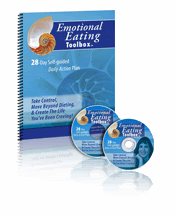
I'm pleased to announce that the Emotional Eating Toolbox(TM) 28-day Program for taking charge of overeating and emotional eating is now available as a soft cover workbook and CD set! The previous version, which was downloadable, is no longer available (thanks to those who helped me with my Spring cleaning!). The workbook is hefty--150 pages--and, just as it was before, it's packed with powerful tools, individualized strategies, templates and schedules to help you take control, move beyond dieting, and put food in a much smaller place in your life. If you check out the new graphic on this page you can see the snazzy new cover.
One of the reasons that we moved to a non-downloadable version was because we've had so much interest from groups, programs and support groups who want to purchase the program in bulk quantities and work through it together. If you are interested in volume pricing, please contact us.
Take good care,
Melissa
Sunday, May 11, 2008
Mistakes That Sabotage Weight Loss and Contribute to Emotional Eating: Part One
 One of the biggest mistakes that people make when they are trying to take control of their overeating is to deny their hunger. This is often the result of lots of bad diet advice. It goes something like this: "The hunger is all in your head, you don't really need any more food, it's "just" emotional hunger, so ignore it and don't give in to it."
This advice might work in the short-run--sometimes. In the bigger picture, it is NOT a recipe for success.
I'm here to tell you that the hunger IS real. When we feel hungry even though our body doesn't actually need fuel, we need to respect that we are thinking about food for some reason. The odds are that we are hungry for something. It might be stress relief, or a break, or love or even excitement or sleep.
Our job, if we want to take control of emotional eating is not to deny the hunger, but to acknowledge it, respect it, and develop the tools to identify whether it truly is a hunger that will best be fed with calories, or whether we hunger or yearn for something else, and we're just using food as a stand-in. Make sense?
It's only by respecting and exploring our hungers and feelings and needs that we can start to develop better strategies for feeding ourselves--strategies for meeting our emotional needs, our feelings, and our desires.
This can be tricky, and for many who struggle with emotional eating, it's a whole new world. Some of us have gotten so good at addressing our emotions, needs and desires with food that we don't even register the emotional part anymore--our brains try to convince us that we REALLY ARE just hungry for food. What we may need then, are more effective tools for clarifying and responding to those hungry feelings. Lots of people need help with that--and a good coach or emotional eating program can be the best resource we provide ourselves. What we really don't need is to ignore what is going on. Because if we do, the thing we are hungering for--whatever it is--never truly gets fed and never really goes away. And if we haven't figured out any other way to cope with it, eventually we overeat, blame ourselves, and the cycle begins again.
Take good care,
Melissa
Sunday, April 27, 2008
Emotional Eating Toolbox(TM) Spring Cleaning Deal!
There are some exciting changes coming up at Enduring Change, and our Emotional Eating Programs. In the spirit of my last post, you are invited to help with some of my Spring Cleaning. There are a limited number of Emotional Eating Toolbox 28-Day Self-guided programs available at a discounted price. The information about the program and about how to order is here. (this is the self-study program, NOT the Emotional Eating Coaching Groups). A limited number have been set aside. Type in the coupon code springfever at checkout and the price will be discounted by $34! When they're gone, they're gone!
Take good care,
Melissa