You might want to consider blogging. A new, soon to be released study concludes that people who blog feel less isolated and more satisfied with their friendships. The study tracked Myspace users who also blogged and found that after two months of social networking and blogging, participants reported feeling less anxious, depressed and stressed and bloggers in particular felt better about their current social support and friendships than nonbloggers.
The authors concluded that blogging can be a powerful promoter of creative, intuitive and critical and analytical thinking.
Contrary to stereotypes of bloggers as geeks isolated in their private internet world, blogging has the potential to create community, connection and support. For many who are struggling or are shy or not feeling so great about themselves at that particular moment, reaching out online or expressing one's self in a blog post can feel both more accessible and perhaps even emotionally safer. Apparently, it might also leave you feeling better.
What do you think?
Melissa
Monday, July 7, 2008
Do you eat because you are anxious, unhappy, stressed or lonely?




Sunday, July 6, 2008
Are you on Facebook?
 Are you on Facebook? If so, come visit. You can now access Peace With Cake directly on our Facebook page (you don't even have to be a registered user to use this link). Come visit when you have a chance and consider becoming a "Fan" (just click the link on the right side of the Facebook page) or send me a Friend Request.
Take good care,
Melissa
Is perfectionism sabotaging your weight loss?
 Is perfectionism sabotaging your weight loss or your relationship with food? It might be. Trying to get it "perfect" can actually make emotional eating much worse.
Do you wake up in the morning thinking “today is a fresh start (with food)?”
Does your newest approach to eating inevitably fall apart because you’ve “blown it” and feel your efforts were ruined?
If you deviate from your plan for your eating, do you react by overeating even more?
Do you have expectations for “ideal eating” that are so unrealistic or rigid that you could never imagine sticking with them for a lifetime? Or—do you begin to feel deprived just thinking about how you “should” eat?
If you answer “yes” to these questions, chances are your inner perfectionist is having a field day sabotaging your relationship with food.
The truth is, nobody gets it “perfect” (whatever THAT is). An all-or-nothing approach will sink weight loss efforts fast. On top of that, not only are we destined to fail if we expect perfection, but our inner perfectionist usually contributes a double whammy by heaping on the guilt and self-blame when we DON’T get it perfect. For many of us, that alone can be a recipe for emotional eating.
Question for the day: Do you have an inner perfectionist and if so, how is she or he getting you into trouble or making life harder? What tools do you have to take back the reins and put the perfectionist--and food--in it's place?
Take good care,
Melissa
Tuesday, July 1, 2008
Creating Enduring Change With Emotional Eating: Maintaining
The most consistently neglected part of the weight loss process is the phase of “maintenance.” Without solidifying our ability to maintain, our chances of creating lasting change in our relationship with food or enduring weight loss are slim. Change is not a one shot deal.
Just as quitting smoking involves a lot more than throwing your cigarettes in the trash, conquering emotional eating is something we do over and over again, in big and little ways, as we build new patterns and tools for coping and new ways of being in our worlds.
Many of my clients come to me after significant periods in their lives when they’ve walked on the road they want to be on. They’ve taken charge of their relationship with food. They’ve found the groove of eating the way they wanted to eat. They’ve lost the weight and felt the excitement and the satisfaction.
And then something happened.
Their focus on food and eating increased. The activity level decreased. The cravings changed. The weight came back. And now they are feeling defeated and tired and they have a bit (or a lot) less hope then they did before. They're usually feeling pretty guilty and mad at themselves which makes things even harder.
Change is not a one shot deal.
You probably know how it works. You’ve made a successful change. You feel proud. You feel like celebrating. Or you decide you really don’t need to be quite so disciplined anymore. You start to slack off or you loosen the reins a bit. Is this a bad thing? Haven’t you earned it? How do you know?
Maintenance is not something that happens automatically—AND maintenance is the stage where all the hard work can pay off, or can start to unravel. Most of my clients are very clear that they know HOW to make changes. They know how to lose weight (if that’s their goal). What they struggle with is keeping it off. What they don’t want to do is lose the weight and then have to lose it AGAIN.
Working at maintenance isn't as dramatic or visibly rewarding as starting something new. Because "maintaining" is the goal, you aren't seeing the motivating external changes or smaller numbers on the scale. Your clothes fit the same way everyday. But putting a firm foundation for long term maintenance in place is crucial. Sometimes this is the phase where extra support and accountability can pay off big.
My advice to you: don't hesitate to get the support you need to establish a solid foundation of maintenance. You've worked too hard to create the changes you've begun to put into place. What do you need to do to make sure that you don't short change yourself?
Take good care,
Melissa
Monday, June 30, 2008
Emotional Spending?
 Here’s more evidence that it pays to be mindful of your mood—or more accurately—that it might literally cost you if you aren’t. A recent study by researchers at Harvard, Carnegie Mellon, Stanford and the University of Pittsburgh found that study participants who watched a sad movie clip were later willing to spend four times more money on a fancy water bottle than those who watched a movie clip that was emotionally neutral.
The researchers hypothesize that feeling sad may cause us to become more self-absorbed and devalue our possessions, then try to increase our sense of self worth by purchasing something.
Whether that’s the reason, or whether participants wanted to distract themselves or boost their mood by buying something new, the results of the study remind me a lot of the process of emotional eating.
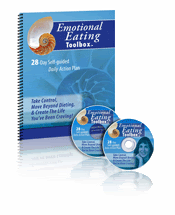
Like emotional eaters, it’s quite possible that the emotional shoppers are more vulnerable to trying to find “a quick fix” for or a distraction from the negative emotional state they are experiencing. Learning the tools that allow you to slow down, identify your emotions and strategize about how to respond to them is incredibly powerful. Clients who use the Emotional Eating Toolbox™ program often tell me that they quickly find the tools they learn help them in many aspects of their life—not only with overeating and weight loss.
When we can learn to be present in the moment and aware of how we are feeling and what we are needing, we tend to be much better equipped to make choices that are in our best interest.
What do you think?
Melissa
Friday, June 20, 2008
Emotional Eating: Creating Enduring Change
 I’ve spent a lot of time in airports lately. That means that I’ve spent a lot of time at the news stand, scanning the covers of magazines, looking for some nice relaxing reading material. In my browsing, I’ve been struck by how magazine articles emphasize making changes or starting something new.
“Get in bikini shape,” "The diet that works," “Exercise programs for 6-pack abs.” You know what I’m talking about--headlines with big sparkly promises that aim to excite us about undertaking a new project.
Given the appropriate level of enthusiasm, most of us are able to get motivated to start something new. It’s fresh territory, a clean slate, a new approach.
Here’s what the magazines don’t talk about: successful change doesn’t happen with just a bright shiny new program. The right program is only one tool. Enduring change requires stamina. Changes that last require us to pace ourselves. It’s not just STARTING the exciting new project; it’s continuing to slog ahead when the going gets tough and when the excitement wanes.
With emotional eating, stamina means having the courage to stop and ask ourselves why we are reaching for the Doritos, even on the days when we’re not sure we really want to know the answer. Enduring change requires starting the project or the program, riding the wave of any honeymoon phase we are lucky enough to experience, and then recognizing that the biggest payoff comes when the easy part stops and we start feeling stuck.
It’s really true. When you hit that spot where you feel like “here we go again, this is where it all falls apart,” and you stick with it, you keep slogging ahead, you put your head down and you keep taking small steps forward--THAT’S where the big payoff happens.
It's hard. Many people can’t do this alone. We have too many inner critics--powerful inner perfectionists, who talk us into sabotage and failure. This is the place where you can pay off big if you call a friend or a role model. This is one of the biggest benefits of hiring a coach. It can take courage to state that the change you are trying to make is important enough to reach out for help, but investing in yourself and investing in moving forward is a powerful step. The experience of learning how to bypass those internal critics and those old stumbling blocks is priceless.
As enticing as the magazine headlines are, many times we don’t need to start over. What we need is the encouragement and the accountability and the support and the reminders to KEEP GOING. We need that voice in our ear reminding ourselves that we really truly are getting somewhere. Small steps, moving forward--that's what pays off.
Take good care,
Melissa
How to Identify Emotional Eating: Ten Signs
 I'm often asked about how to identify whether or not emotional eating may be an issue. Emotional eating is not always easily identified. Here are some patterns that are likely to indicate that some kind of emotional eating is going on:
1. The hunger comes on suddenly and the need to eat feels urgent--physiological hunger comes on slowly and it's okay to delay eating.
2. You keep eating even if you aren't hungry anymore or the hunger doesn't go away even though you are full.
3. You eat to the point of physical discomfort.
4. You don't know whether you were hungry or not when you ate.
5. After you eat you realize you aren't really aware of how much you ate or how it tasted.
6. You have feelings of shame, guilt or embarrassment after eating.
7. You eat because you are bored, tired, lonely, excited.
8. Hunger accompanies an unpleasant emotion--anger, hurt, fear, anxiety. Emotional eating begins in your mind--thinking about food--not in your stomach.
9. You crave a specific food and won't feel content until you have that. If you are eating for physical hunger, any food will fill you up.
10. You keep eating (or grazing, or nibbling) because you just can't figure out what you are hungry for. Nothing seems to hit the spot (physical hunger goes away no matter what food you choose to fill up on).